If there’s one thing that baseball fans can agree on, it’s the fact that it’s hard to pitch at Coors field. It’s not easy to pitch at any Major League ballpark, but the altitude at Coors Field makes it that much harder for a pitcher to get batters out. Top pitchers vehemently avoid signing with the Rockies during free agency due to worries about lost value due to the Magnus Effect, where less air pressure allows for a rapidly spinning ball to move less and therefore deceive hitters less, and the Rockies are forced to either develop pitching through the draft or sign low-level free agents with little value left. The problem that the Rockies have faced recently is that they have not been able to develop good pitchers out of the draft, which has led to much of their current turmoil.
When the Rockies have succeeded in the past, much of their success can be attributed to good home-grown pitching. During their last playoff run in 2018, 4 out of 5 pitchers in their starting rotation were home grown, with all of them making their Major League debuts with the Rockies. Recently, the pitching pipeline has mostly dried up for the Rockies as most of their pitching selections have not developed well, but there seems to be a slight rejuvenation in the starting pitching pipeline.
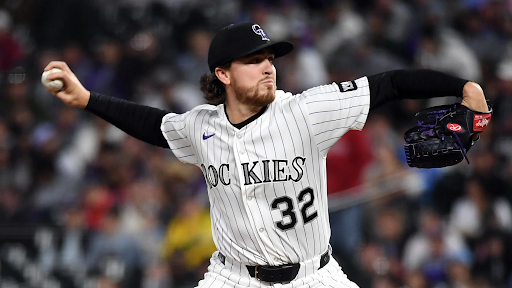
Enter Chase Dollander: The Rockies’ 1st round selection out of the University of Tennessee in 2023. The 24 year-old right handed pitcher is off to one of the better starts to a season in recent memory, and some of his success has come at Coors Field, which was his worst nightmare in 2025.
Dollander didn’t trot out to his first appearance this year with the same approach that he put forth in 2025, where he had shocking splits at home and on the road. Last year, Dollander was stellar in away games with a 3.46 ERA (Earned Run Average) along with a .200 opponent average and a 1.17 WHIP in 52 innings, but at Coors Field, he put up an ERA just south of 10.00. Much of this was due to the quality of contact at home vs. on the road; he allowed 7 more barrels (2.7% higher barrel rate), 6 more home runs, 29 more hits, and a wOBA .141 points higher. This ultimately led to him having one of the biggest examples of the Coors Field effect in modern history, and gave him a lot of question marks moving into the season because of how bipolar he is in Colorado versus how talented he is closer to sea level.
Dollander has come into 2026 as a new pitcher. Mechanical and arsenal tweaks seem to have brought down the variation between sea level pitching and high altitude pitching, but most importantly in his arsenal. Dollander’s best pitch since high school has been his 4-seam fastball, but at Denver’s altitude, 4-seamers aren’t as effective. Thinner air restricts the amount of vertical & horizontal movement that usually makes a batter swing and miss, and although Dollander’s average 4-seamer velocity was 98 mph in 2025, (3 mph > league avg.) It was his worst pitch at a -11 run value. A pitch that keeps its movement profile better with thinner air is a sinker; like a fastball but with a little more armside movement. Dollander did possess the ability to throw a sinker in 2025, but he only threw it 9.8% of the time, good for his 4th-most thrown pitch during the season. This low usage was also due to only starting to throw it at around the midpoint of the season, but this year, his sinker usage has jumped up to 21%, which is only second to his 4-seamer. Along with the addition of a sweeper (1.8 RV/100) to his arsenal to make his pitch mix at an even six, this subsequently made his fastball usage go from 49%–>36% in just one year. Although Dollander’s 4-seam fastball might not profile incredibly well at altitude, it’s still an outlier velocity-wise, and with 5 other pitches in his pitch mix over 5%, an increase in his pitch variation leads batters to not be able to sit on his fastball like last year.
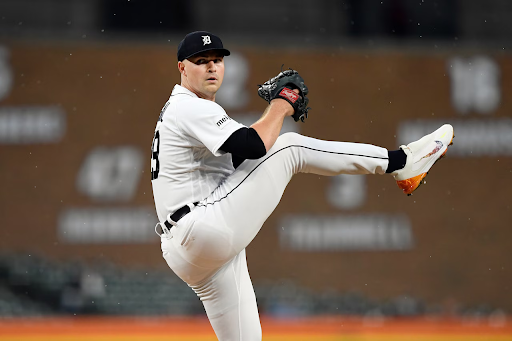
Chase Dollander’s mechanics might look similar compared to last year, but subtle changes have made an eventual big difference. In this video, with the Dollander on the left being himself in 2026 and the Dollander farther to the right being himself in 2025, there’s a vast difference in mechanics and delivery time. Although 2025 Chase Dollander does appear to have a smoother delivery, he takes 0.77 seconds longer to deliver the ball with a lot more room for variation in his delivery. Dollander eliminated his glove tap, high leg kick, and excessive arm action. He has seemed to even speed up his arm in the beginning and towards the end of his delivery, but I’m unsure of how that could affect his arm health in the future. The main takeaway from his mechanical changes is that he has allowed for less variation in his motion, which leads to better body control, and ultimately, better command of the zone. This is important for every pitcher, but especially a pitcher in Coors Field where a mistake by a couple of inches could mean a home run instead of a fly ball to the outfield.
After all of these changes, there’s still a lot of season to go. We’ll have to see if Dollander will be able to keep his stellar start to the season going, as he still doesn’t have the best hard-hit numbers but is improving every start. He’s only 24 years old, the youngest starting pitcher on the team, and the Rockies might need to rely on him towards the end of the season.