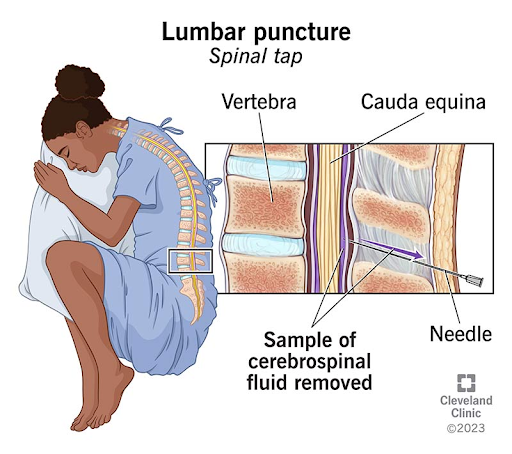
Lumbar punctures, commonly called “spinal taps”, are medical procedures used when blood cultures, or blood testing, does not deliver enough information. Although mostly used in the Emergency Room, they can be performed in scheduled appointments for numerous reasons. Patients with, or screening for, cancer, meningitis (inflammation in tissues around the brain and spinal cord), encephalitis (brain inflammation), neurosyphilis (bacterial infection in the brain), and many other things may decide to have this procedure performed (Mayo Clinic). Though voluntary and typically covered by insurance, it may be an out of pocket expense if insurance does not deem the procedure medically necessary.
The first step in a spinal tap is to prepare the equipment needed. A thin, tubular needle with a stylus and open end is used to capture the fluid. Additionally, an iodine solution will be used to disinfect the skin. Once the procedure begins, the patient will either lie on their side or be draped, face down, over a stable surface. Doctors and occasionally skilled nurses do this in order to find the vertebrae and spacing between, making it easier to access the spinal fluid with the needle. Next, the topical iodine solution is applied to the skin for disinfection and sterilizing the area. The needle is then guided between the vertebrae L3 and L4 in the lumbar region, which avoids the actual spinal cord. When it reaches the spinal fluid, medically called cerebrospinal fluid (CSF), it is collected in a vial that will later be sent to a lab to be examined. The procedure finishes by the needle being expelled and a bandage is placed on top of the entry site.
Though considered a particularly safe procedure, there can still be side effects or complications. The most reported (approximately 25% of patients) is a headache. It is minor in some but more intense in others. This occurs when excess cerebrospinal fluid leaks from the puncture hole, causing lower pressure (in the fluid) around the brain and drying out the area, thus causing a headache (NIH). Moreover, and much less frequently, other complications can occur; including from the site of insertion and occasionally internal bleeding in the epidural space (the space surrounding the spinal cord). Additionally, but very rarely, herniation can occur in patients with high intracranial pressure (high pressure in the skull surrounding the brain). A herniation is explained as “an abnormal condition or process in which an organ or other tissue protrudes through an opening, as in the organ’s surrounding walls or some other narrow space” by Dictionary.com. When talking about the brain, a herniation would mean a dislocation or shift in the skull, causing brain tissue to move, resulting in swelling and restricted blood flow. This can be fatal if not treated immediately, but precautions such as giving the patient an MRI or CT scan before the tap to assure there is no excess pressure around the brain.
Ultimately, this procedure can be highly valuable when looking for certain disorders or infections as it can potentially save lives through their diagnoses. It is efficient, safe, and gives accurate information for concerns one may have. Whether the patient wants to be tested for something as intense as leukemia or as mild as simple meningitis, getting a spinal tap may be the best option for diagnoses and understanding next steps.