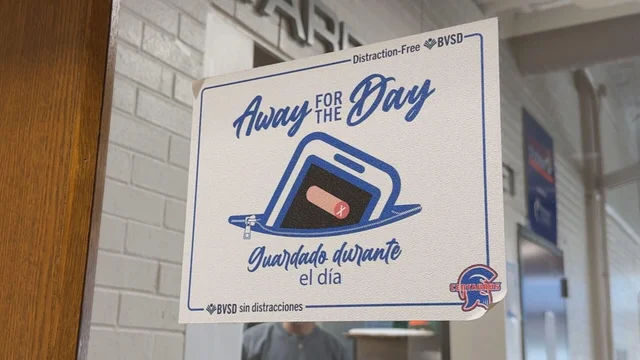
Last year, on January 7th, 2025, students started their spring semester with a key change: the loss of cell phones. Due to new BVSD policies and restrictions, students were now under a “bell to bell” policy, prohibiting them from using their cell phones during the first bell to the final bell. With the initial outcry against the phone ban and the integration of it throughout the past two semesters, its effects and enforcement are unknown and have certainly been commented on, with many students divided on whether or not the phone ban was really necessary.
The Effects of the Ban
The purpose of the phone ban was to encourage an environment where learning and interacting with fellow students is more connected, as stated in the Distraction-Free BVSD article; “our students learn best and are better connected socially when they are able to focus on academics and connections with fellow students” (Distraction-Free BVSD – Boulder Valley School District). However, many students, parents, and teachers, especially during the initial backlash, wondered if the restrictions would actually improve grades and participation like promised.
Many sources such as Boardhawk and FOX news note that the phone ban has had many positive and negative effects within the school, with FOX reporting an increased community and library attendance. Some students echo this, like Centaurus sophomore Grasyon Ziaja, who emphasized that “anyone who I was close with, I got way closer with because I could talk to them more in person instead of texting and talking.” Effects like these are ones that BVSD was looking for, especially when it came to bringing their students together and increasing their desire to learn. However, the phone ban has also been hard to implement over the course of the past few months, with teachers saying they must take phones 10-20 times a day, as per FOX news.
The Student Opinion
Since the original backlash of the ban, students have had the chance to settle in and adjust to the effects of the phone ban over the course of three semesters, producing mixed results. Many have been able to ease into it and slowly accept it, while some others still have choice words.
Grayson Ziaja expressed,“This year, I’ve honestly accepted not using my phone as much, and when I use it, it’s not for anything too important.” Some students seem to be able to understand and adjust to the phone ban, especially after a couple semesters. It’s been an integral part of Centaurus administrative focus for the past year, so it’s no surprise that they’ve done everything they can to make sure students can orient themselves accordingly.
On the other hand, many other students, such as sophomore Tyler Nelson, have some other thoughts. “I feel like there’s better ways to improve learning other than phones, especially during lunch and in close proximity to campus,” he stated. “I’ve been off my phone a lot more, which is good, but I also like to listen to music, and with the phone ban, I can’t do that much anymore.” The phone ban has led to better habits with phone usage at schools, but it also causes some people to lose interest in some things they used to do a lot with their phones, such as listening to music.
It seems that, although the school has a lot of time to adjust, many students are still on the fence over whether or not the policy is arbitrary.
The Fluctuation in Enforcement
The enforcement of the phone ban has been one of its most emphasized elements. The administration has been amazed at the efficiency of the process, as per our principal Carlyn Carroll stating in a PBS article, “I have half the discipline issues and bullying”. Meanwhile, many students say that the security officers are too strict, while others see some leniencies in the policy. With the rise and gradual decline in acknowledgement towards the policy, it’s important to measure how much the phone ban has been enforced over time, especially after it being a major focus in the school.
When asked about how he felt about the enforcement of the phone ban, Tyler emphasized that “it’s been getting too aggressive.” He details how he feels that the security often does too much with the phone ban, some with questionably intense demeanor, stating, “I think they just snatch it up whenever they can, it just feels like too much.” Grayson echoed this sentiment, but also detailed that some areas of the school have less enforcement than others, affirming that, “Some areas have a lot of enforcement in those areas, and some other ones don’t have a lot of enforcement.”
Enforcement of the ban has always been the hard part, since the phone ban began and continued through the other semesters, and while things have seemingly got into a routine, much work is still to be done.
With everything that the policy has affected within our school, including the many positive and negative things that have been associated with the ban, it must be remembered that the phone ban has only been active in two semesters. Progress is far from over when it comes to the policy, and with the third semester starting up, the school hopes to have much more.