Chess, an esteemed game of pure skill, has been synonymous with gentlemanship and elegance for centuries. However, when the game’s best players of today are pitted against each other, countless controversies and petty arguments find themselves sharing the spotlight with the moves on the board. In short, from jeans-gate to the king toss called the “degradation of modern chess”, professional chess is a mess.
The Fight for Control
The International Chess Federation, known by its French acronym FIDE (“fee-day”), is supposed to be the primary governing body of the game. However, FIDE doesn’t have as much control over chess as they like to pretend to. Though the most prestigious events, such as the World Chess Championship and its qualifying tournaments, are run by FIDE, the majority of money made by chess players comes from private, invitational, over-the-board tournaments, online tournaments hosted by Chess.com, and more recently, the Esports World Cup.
FIDE’s loose grip on the world of chess has led some to compete for its role. In 1993, World Champion Garry Kasparov and his soon-to-be World Championship opponent Nigel Short announced the Professional Chess Association (PCA), a competitor to FIDE, after a dispute over the planned, FIDE-organized Championship match. The highly-respected grandmasters elected not to compete in FIDE’s match, instead competing in their own match organized by the PCA, while the FIDE match was held with different players. Because of this dispute, until 2006, there were two world champions at any given time.
After the reunification, FIDE became very territorial over the “World Championship” title. This was realized when Freestyle Chess, an organization meant to popularize Chess960 (a variant of chess where pieces are shuffled and opening moves cannot be memorized), announced the Freestyle World Championship, and FIDE was not happy—they threatened legal action against Freestyle Chess as well as disciplinary action against participating players. What was ultimately a long battle, fought mostly on Twitter, ended with Freestyle Chess dropping the World Championship name. While it was resolved relatively peacefully, several weeks of fighting over two little words is not indicative of a confident governing body.
Players Need Invitations

One consequence of privately-organized invitational tournaments being so prevalent is that chess players’ income depends heavily on getting invited to them.
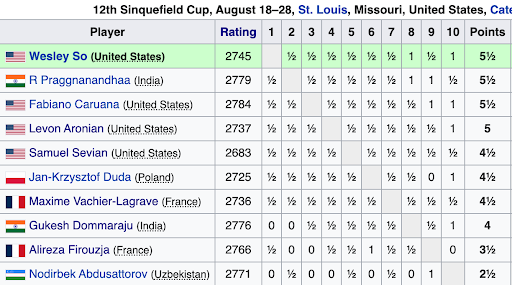
Each month, FIDE publishes World rankings using the Elo system, in which each player is given a “rating” that grows or shrinks based on tournament performance. Invitations are often based heavily on these rankings, and so much of a player’s income being tied to this number results in behavior that hinders the spirit of the game. If a player has a bad tournament, they will fall in the rankings and have trouble getting invited to more tournaments. This fear results in lots of risk-free, boring chess in tournaments where the only stakes are prize money. The following crosstable is the results of a recent chess tournament with an over $300,000 prize fund. Each “½” represents a draw:
Hikaru Nakamura (USA, World #2) has a different approach, however. Though Nakamura generally scores well in over-the-board tournaments, he rarely plays them. Instead, most of his time is spent live-streaming online chess. With online content creation, he makes more money than he ever made from tournament prize funds, and he has also made himself the most famous chess player not named Magnus Carlsen (NOR, World #1).
While seeing a super-grandmaster play without all of the traditional pressures associated with losing is certainly exciting, the specific player in question is also a driver for drama and toxicity. From berating his pregnant wife’s chess live on stream, to calling Alireza Firouzja’s (FRA, World #6) family “crazies” after losing to him in an online tournament, Nakamura has a long history of bad sportsmanship and rude behavior—and the chess world has allowed him to become the face of online chess.
A World Championship without the Best Player
On July 20th, 2022, Magnus Carlsen, the man universally recognized as the best chess player in the world, announced he would not play in the 2023 World Chess Championship. As a result, a World Championship match was held between Ian “Nepo” Nepomniachtchi (RUS, then-World #2) and Ding Liren (CHN, then-World #3). The match, won by Ding, was called an “amputated event” by Garry Kasparov, who further stated, “The match between Nepo and Ding is a great show, but it’s not a world championship match”. Similar delegitimizing of the World Championship title became stronger when Ding performed poorly in many big tournaments after winning the title. Carslen remarked that Ding had been “permanently broken.” Less than two years later, Gukesh Dommaraju (IND, then-World #5) beat Ding to become the current and youngest undisputed World Chess Champion, and he also had a few poor performances as Champion.
Another consequence of Carlsen’s absence is that the World Championship title is seen, by many top players, as up for grabs. This makes it all the more important for its qualification system to reward the best-performing players. Though this always proves a challenge, FIDE falls far short of accomplishing this.
To provide some context, the World Championship is a several-game match between the reigning World Champion and the winner of the “Candidates Tournament”. Since 2013, the Candidates has been an eight-player double round-robin, and for the 2025-26 cycle, the eight players were chosen as follows:
-Two spots from the “FIDE Grand Swiss” tournament
-Three spots from the “FIDE World Cup” tournament
-The winners of the 2024 and 2025 “FIDE Circuits”
-The person who averaged the highest Elo rating on the FIDE World rankings in the last six months of 2025, given that they’ve played 40 games in the 2025 calendar year
The FIDE Grand Swiss and World Cup are both huge tournaments consisting of the top hundred-or-so players. Both tournaments have been criticized for being too “random” and unpredictable, leading to an exciting viewing experience but not necessarily producing the best candidates. However, they have also been praised for giving players that don’t typically receive invites a chance to make a name for themselves. For example, the relatively unknown Matthias Bluebaum (DEU, World #34) placed second in the 2025 Grand Swiss. Afterwards, he was invited to a super-tournament in the Netherlands and placed sixth out of fourteen.
On the other hand, the yearly FIDE Circuit rewards points for tournament placements over a calendar year. This, in theory, rewards players who are consistent throughout the year. However, many points are rewarded for invitational tournaments, disadvantageing players who miss big invites. Several top players have also criticized the circuit for rewarding points in a mathematically unsound way and for pressuring players to compete for little money.
The rating spot, however, is perhaps the most problematic. Throughout 2025, Hikaru Nakamura maintained a significant lead in the world rankings, but played few games at the beginning of the year. To ensure he qualifies for the Candidates, he signed up for many of what he calls “Mickey Mouse tournaments”, which are random local tournaments with everyday players. Among these tournaments included the Louisiana State Championship (Nakamura lives in Florida) and the Iowa Open. This isn’t the first time the rating spot has been exploited; in 2023, Alireza Firouzja organized private matches with purposefully-chosen opponents in an attempt to increase his world ranking. And in 2019, Anish Giri (NED, current World #7) withdrew from that year’s Grand Swiss to avoid rating loss. It is clear that having such a gameable metric as qualification for such an important tournament is extremely flawed, and Nakamura theorized that FIDE has been hesitant to remove the rating spot primarily to give Carlsen an easy way to return to the World Championship cycle if he so chose.
Everyone is Paranoid About Cheating
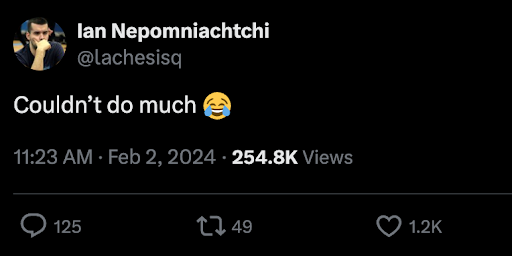
Cheating is perhaps the biggest driver of drama in the chess world, which makes sense; if left unchecked, cheating can pose an existential threat to the integrity of the game. It is especially a fear with online tournaments, with anyone able to open a chess engine on their phone and beat any human player. Technology does exist to detect this kind of cheating, but it may be impossible to know if someone’s cheating in a more subtle way. Maybe someone is only checking the computer every few moves, maybe they’re using a weaker engine that can still provide hints, or maybe they just have a bar telling them who’s winning and how strongly. Because of this, many players are quick to accuse their opponents of cheating if they play too well.
In 2022, the story of Hans Niemann (USA, current World #18) beating Magnus Carlsen in a shocking upset went viral. After this loss, Carlsen withdrew from the tournament, and later directly accused Niemann of cheating “more — and more recently — than he has publicly admitted,” referring to Niemann’s public admission to cheating online twice in the past. Many believed Carlsen, and Niemann’s reputation was severely hindered. Since then, Niemann has climbed the rating ladder and put up consistently good performances in major tournaments. In 2025, Anish Giri defended Niemann, stating, “I was waiting for the proof. But at some point, I realized, okay, there is no proof. They don’t have proof. And he was treated like he was guilty. And nobody convinced me that he was guilty at all. I found the way he was treated extremely unjust”.
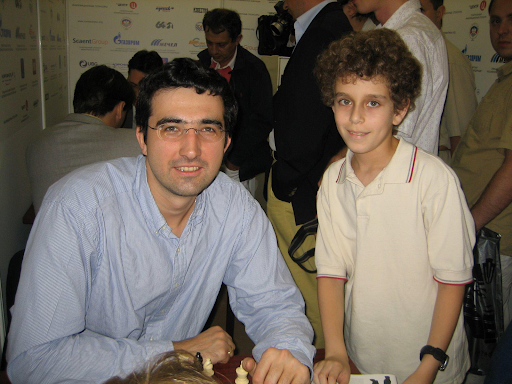
However, Vladimir Kramnik, who was World Chess Champion from 2000 to 2007, takes accusations of cheating to another level.
In 2006’s “toiletgate,” Kramnik himself was the target of cheating accusations. His World Championship opponent, Veselin Topalov, accused Kramnik of cheating because he was entering his private bathroom too frequently. Because of this, it was decided that there would be a single bathroom for both players. Kramnik then demanded he keep his private bathroom, and forfeited the next game.
Nearly two decades later, it is Kramnik launching accusations at other players, and he does so relentlessly. Kramnik began his crusade when Hans Niemann beat him in an online game. Kramnik insinuated that Niemann’s play was strange, believing some moves were played more quickly or more slowly than would make sense. Kramnik continued by launching accusations at more players, including Hikaru Nakamura, whose online play he believed was statistically anomalous. Despite many players coming to Nakamura’s defense, and despite actual statistics experts finding issue with such claims, Kramnik continued to double down.
But Kramnik’s biggest target was Daniel “Danya” Naroditsky, a widely-loved chess player and commentator. Naroditsky had always confused players; he was top-tier when it came to speed chess (especially online), but he wasn’t a top-100 player in longer time controls. Despite this, there was never any credible evidence that he was cheating, and many top players, such as Carlsen and Nakamura, consistently commended him for his play. But Vladimir Kramnik needed the world to know that he was suspicious of Danya, and for over a year, Kramnik would continuously and publicly harass him over this suspicion. Naroditsky admitted that Kramnik’s accusations took a toll on his mental health, and he called Kramnik “worse than dirt”.
Tragically, on October 19th, 2025, Daniel Naroditsky was found dead in his home at the age of 29. His death was later declared accidental.
In his final livestream, Naroditsky showed signs of mental unwellness and his friends were begging him to end the stream. He hesitated, being scared that he would end stream and begin to play well off-camera: “Ever since the Kramnik stuff, I feel like if I start doing well, people assume the worst of intentions”. Many players believed that Kramnik’s relentless bullying was partly responsible for Naroditsky’s mental health issues, with Nihal Sarin (IND, World #23) stating, “[Kramnik] has kind of literally taken a life”.
FIDE has launched an ethics investigation into Kramnik, which is still pending.
Emil Sutovsky is the Worst
After Naroditsky’s death, FIDE CEO Emil Sutovsky tweeted a strange, 600-word statement blaming players for “virtue signalling and like-grabbing” about Danya’s passing, and for not being there for him when he was alive. He stated: “So, I ask you, alleged Danya’s friends, what did you do to help him for half a year or so? Did many of you write him to ask, whether he is OK?”. Many chess players and fans alike were appalled by his tweet, pointing out that Danya’s close friends were very much helping him through his struggles. Chess YouTuber Levy Rozman stated that if any other sport body leader had made a similar tweet, they would have lost their job.
Earlier that year, Sutovsky tweeted a subtle dig at Rozman, stating that, despite his large following, Rozman didn’t attract enough “real chess fans”. On top of that, Sutovsky is always starting fights on Twitter, taking shots at numerous players and content creators, and, as a whole, promoting negativity in the chess world. Overall, he is a hindrance and an embarrassment to the chess world.
The Good
Despite all the incompetent organization, petty drama, and negativity, I and many others still love following professional chess. There is a beauty in watching one genius take down another by understanding the intricacies of the position ever-so-slightly better. Seeing rising stars, such as World Champion Gukesh, or 14-year-old Yagiz Kaan Erdogmus (TUR, World #37), hungry to make their way to the top is always exciting. It is clear a lot of changes need to be made if chess is to last as a professional sport, but even with everything, there are still so many players interested only in playing their best chess. Arjun Erigaisi (IND, World #11), for a while, was not receiving invites to major tournaments, and he said, “I can choose to sit at home and complain about it or I can create my own path. I chose the latter”.