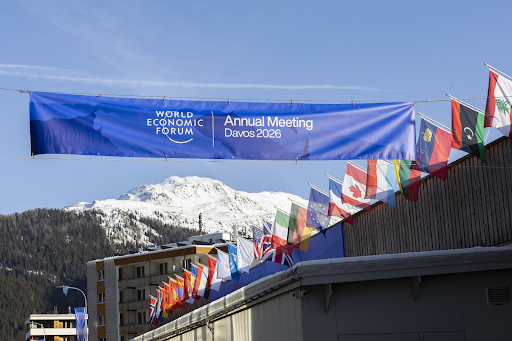
From January 19th to the 23rd, representatives from all over the world met in Davos, Switzerland for the 56th annual meeting of the World Economic Forum. The event, right off the heels of the capture of Venezuelan President Nicolás Maduro and threats to the sovereignty of Greenland, came about in the midst of what many would describe as a collapse of the “rules-based” global order. The extra-territorial capture of Maduro and the possible pressured sale of Greenland underscores a new era where many believe that might overrides mandate. Growing imperialist policies from large countries like China, Russia, and the United States have contributed to ideological rifts between these countries and alliances they share membership with. With the growing upheaval of the contemporary world order, uncertainty in the world is poised to only grow during the rest of the 21st century. Leaders from around the world during the World Economic Forum gave their visions of how to navigate this future, and here’s what you can takeaway:
While large countries are looking to leverage their soft and hard power over the world, Canadian Prime Minister Mark Carney describes that the ‘middle powers’ must focus on leveraging existing domestic resources to bolster the quality of life and economic output of their citizens. Carney emphasized that middle powers – countries like Canada that have moderate economic output – have become increasingly reliant on and subservient to large countries such as the United States and China, and in doing so have partially forfeited the sovereignty of their nations. The Prime Minister proposed two possible futures for the middle powers of the world: either become isolationist and withdraw from global trade, or globalize and create strong political and economic alliances with other middle powers to multilaterally bargain for more mutually beneficial trade deals. Mr. Carney greatly emphasized the latter, and ultimately was praised by a standing ovation; however, isolationism and stepping back from global trade is a common result of instability. Some nations will inevitably cave to economic pressure – despite the hopeful sentiment of Mr. Carney’s speech – and be unable to find the political power to form trade alliances strong enough to face super powers.
A day later, continuing the conference, United States President Donald Trump rebutted many of Mr. Carney’s ideas in a lengthy speech. Mr. Trump described a world that was only prosperous due to the United States’ trade deals, and that countries like Canada and other European nations were oftentimes the only parties benefiting from U.S. trade and military policy. Mr. Trump claimed that before he took office in January 2025, ‘America was subsidizing every nation in the world’. The President later explained that the goal of his administration is to renegotiate the unfair trade agreements between the U.S. and other countries, and would facilitate these agreements by leveraging the economic pressure of tariffs. He added that it is the duty for the U.S. to secure territory that other governments cannot properly secure. The combination of economic retaliation and vague militaristic threats foreshadows a possible future of further economic and geopolitical instability, marked with increasing impediments to smaller nations unsubservient to super powers like the United States.
While most western countries had similar outlooks to Canada, Prabowo Subianto, the President of Indonesia, had a more politically neutral and domestic view of how countries should conduct their economic policy. Mr. Subianto heavily emphasized the importance of peace. He stated simply during the opening of his speech that ‘there will be no prosperity without peace’. Mr. Subianto emphasized that Indonesia must craft trade agreements with all countries regardless of global might, while balancing focus on domestic issues. The Indonesian president highlighted programs for food security, job opportunities, and general infrastructure as key parts of the rapid development of the Indonesian economy. Mr. Subianto concluded human capital was the most important part of the economy, and by investing in the citizens of Indonesia he has built economic confidence and bolstered consumer spending. While not as politically radical as Mr. Trump’s or Mr. Carney’s proposals for the future, Indonesia shows that textbook foreign and domestic policy still have a promising future even in the midst of a tumultuous global order.
The views expressed by global leaders at the 2026 World Economic Forum illustrate a clear evolution in global diplomacy: nations with economic might are increasingly leveraging it, and nations with less are feeling the impacts of strong-arm economic policy. Ambitious global superpowers are using this pressure to politically destabilize their rivals, cement their power, and ultimately facilitate territorial expansion. The contrasting ideals between Mr. Carney, Mr. Subianto, and Mr. Trump highlight the new perspectives that are emerging around the world to meet the demands of the 21st century. Although these three have greatly differing views, they all speak of this period as a time of uncertainty. In the short term, rising global political instability along with economic reclusion may lead to higher prices for foreign items, inflation, weakened buying power for the U.S. dollar, and overall global economic downturn. People of all countries should be increasingly aware of more conservative financial practices, and prepare for a weaker stock market as the turmoil continues.


![Zordan, E. (2025). Gillian Murphy. [Photograph] The New York Times.](https://chswarriorscroll.com/wp-content/uploads/2025/10/unnamed-1200x1200.png)