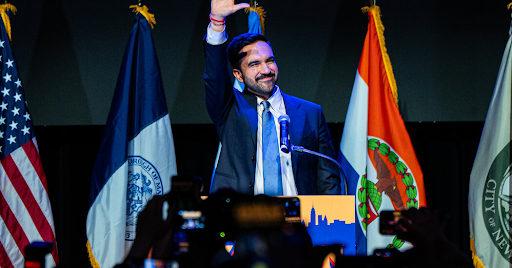
On November 4th, 2025, self-described democratic socialist Zohran Mamdani defeated former New York governor Andrew Cuomo and talk radio host Curtis Sliwa and was elected mayor of New York City.
What’s special about this result is that Zohran Mamdani’s progressive policies are in stark contrast to most mainstream Democratic candidates in recent history. Particularly, Mamdani’s promises to make New York a more affordable city through large-scale changes such as free public transport and universal childcare stand out by appealing to the more left-wing faction of the Democratic Party.
Though strictly a municipal election, the race has garnered attention from many across the country due to its potential impacts on the American political landscape. As a democratic socialist, Zohran Mamdani represents a growing movement in the Democratic Party, joining the likes of Bernie Sanders and Alexandria Ocasio-Cortez–and many see his victory as a sign that a greater emphasis on progressivism will shape the future of the party.
But many oppose Zohran Mamdani’s more progressive vision of the future of New York City, and many prominent Democrats were slow to endorse him. Undeniably, the Democratic Party’s more centrist faction is uncomfortable with a self-described socialist running the largest American city. Many believe that such extreme progressivism is too alienating and polarizing to be a long-term prospect.
However, progressive policies are simply not as alienating or polarizing as many would believe. A poll conducted just before Mamdani’s primary win found that, compared to 26% who wouldn’t, 50% of Americans would support a candidate whose platform included Mamdani’s progressive policies. And in 2020, the same year the state voted for a second Trump term, Florida voted overwhelmingly to increase the minimum wage to $15–a progressive policy that failed to get the support of several democrats in the Senate. Progressivism isn’t what’s polarizing, weak politicians are.
Despite the popularity of progressive policies, the Democratic Party has been hesitant to adopt them. A majority of Democrats in Congress have not endorsed Medicare for All or any similar healthcare proposal, despite over 70% of Democratic voters supporting a government-run healthcare program (and over 60% of Americans believing it is the government’s responsibility to provide healthcare coverage for all). Democrats are not listening to their voters, and continuing to place centrism at the forefront of their campaigns. Kamala Harris, who was initially seen as a glimpse of hope for the Democratic Party to defeat Donald Trump, stated there’s little she’d have done differently to the moderate, unpopular president Joe Biden.
Meeting in the middle is not always the best decision, and it has failed even recently. On immigration, for instance, Democrats had become more right-wing before 2024, with Kamala Harris pledging to support a border wall, something she had previously called “un-American”. This shift to this right did nothing but support Republicans, as 2024 saw a surge in those believing immigration should be reduced. On the contrary, Democrats forced Donald Trump to take a wishy-washy position on a Florida ballot measure meant to increase the six-week restriction on abortion. By standing strong on pro-choice policies, the Democratic Party makes it much more difficult for Trump and the Republicans to bring the electorate away from the popular liberal position. Centrist, compromising policies do little to counter the very-much-not compromising policies of the other side.
The need for progressivism is clear. Wealth inequality in the United States is much worse than it is in comparatively developed nations, and there is a growing discrepancy in how much people are working and how much they are being paid.
This understanding is what separates Mamdani from other Democrats. Mamdani stands firm on his positions and doesn’t pivot on issues where the other side appears strong. Instead, he forefronts the mutual understanding that an economy in which those working full time still struggle to put food on the table is unacceptable, and he offers real solutions to make living affordable–solutions that focus on fixing the root issues from which these insecurities stem, and do not involve scapegoating marginalized communities. The election of Mamdani makes it clear that liberals are ready for something more than unconfident, centrist politicians that handed the country to Donald Trump twice.