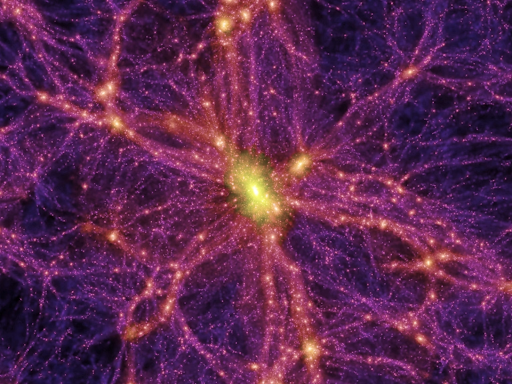
Everything observable to humans — stars, planets, and galaxies — make up only 5% of the conceivable universe; the rest is a mysterious, ghostly matter that actually keeps the universe together. Its mysterious allure and seemingly invisible existence has captured the attention of millions, and is a focus in studies like astronomy, with some famous astronomers including astronomers Vera Rubin and Kent Ford, along with Fritz Zwicky.
Dark matter (and energy) makes up about 85% of our universe and is described as “the invisible glue that holds the universe together. This mysterious material is all around us, making up most of the matter in the universe,” according to NASA. Dark matter is practically the super glue of the universe that keeps the galaxies from tearing apart with their gravitational pull, but their lack of visibility leads to the question of how exactly dark matter is able to exist. Dark matter is inferred to exist because the observable matter in the universe does not provide enough gravity to explain how galaxies and large-scale structures remain bound in place.
Another major piece of evidence supporting the existence of dark matter comes from observations of galaxy rotation curves. In the 1970s, astronomer Vera Rubin, working alongside Kent Ford, discovered that stars on the outer edges of galaxies were rotating at nearly the same speed as stars closer to the center. According to Newtonian physics, these outer stars should have been moving much slower due to weaker gravitational pull, but they were not. This unexpected behaviour suggested the presence of a large amount of unseen mass influencing the galaxies’ motion. NASA explains that without dark matter, “galaxies would fly apart because the gravity of their visible matter alone is not strong enough to hold them together” (NASA). These findings provided some of the strongest observational evidence for dark matter and helped solidify its importance in modern cosmology.
Additionally, the theory of dark energy is tied to dark matter. According to UChicago News, dark energy is “a term scientists use to refer to whatever is causing the universe to expand faster over time” (UChicago). Basically, dark energy is created by dark matter and it is what enables the universe to continue to expand and adapt to growth of itself, working hand in hand with dark matter to ensure a stable universe. However, current research is not strong enough to suggest a definite birth of the energy, a recent discovery suggests black holes may have something to do with it. A study documented by Astronomy.com says, “If black holes do indeed interact with the evolving space-time around them in this way, gaining mass and energy proportionally as the universe expands, dark energy could arise entirely from the process”.
In the end, countless additional questions are to be answered by new research, and no theory can be fully confirmed from what scientists currently know. As more research comes out, it can be expected that the mysteries of dark matter and energy will be unraveled and long running questions about our universe will be answered.