Few cinematic objects are as instantly recognizable as the lightsaber. Its glowing blade serves not only as a weapon but as a symbol of heroism, conflict, and mythology within the Star Wars universe. The lightsaber’s journey from a simple concept to a fully realized on-screen object reflects the extraordinary creativity and technical innovation of Lucasfilm and the Industrial Light & Magic visual effect company (ILM), a company that is part of Lucasfilms. One fascinating aspect of its development is that George Lucas originally envisioned lightsabers as colorless, white blades, but ultimately chose distinct colors to improve visual storytelling and clarity during action sequences. From its origins in the 1970s to the high-tech duels of the prequels, the lightsaber evolved through a combination of practical effects, post-production craftsmanship, and digital enhancements.
When Star Wars: Episode IV – A New Hope began production, no existing technology (in 1976) could create a glowing, durable lightsaber blade. The earliest props consisted of rotating rods coated with reflective material. The initial concept, including Lucas’s original idea of white blades, aimed to convey a pure energy weapon without relying on color. However, during post-production, the team realized that giving the lightsabers distinct colors—blue for Jedi, red for Sith—would help audiences follow the battles and differentiate the characters. The props were then enhanced with rotoscoping, a painstaking frame-by-frame animation technique that added the now-famous glow. This analog method, though labor-intensive, gave the lightsabers their mystical aura while maintaining a tactile feel on screen.
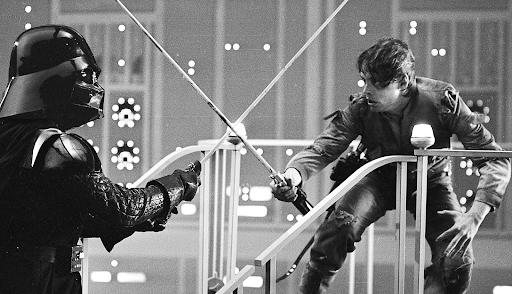
By the time The Empire Strikes Back and Return of the Jedi were produced, the lightsabers had evolved into sturdier props that allowed more dynamic choreography. ILM refined optical compositing (the traditional filmmaking technique of merging multiple film elements like live action, miniatures, and matte paintings), ensuring the blades appeared consistently bright and colored in every scene. The sound design, crafted by Ben Burtt using a combination of projector hums and electrical feedback, further defined the lightsaber’s identity, making the weapon feel alive and powerful. The careful balance of practical props, visual effects, and sound helped the lightsabers maintain a sense of realism despite their fantastical nature.
The prequel trilogy represented a dramatic leap forward. By the late 1990s and early 2000s, lightweight rods covered in colored tape were paired with digital enhancements to create precise, glowing blades that could follow fast, acrobatic choreography. This innovation enabled far more complex fights, including the double-bladed saber of Darth Maul and the curved-hilt saber of Count Dooku. Digital effects allowed the glow to remain consistent during rapid movements, giving the prequels a new level of visual energy without sacrificing the iconic look established in the Original Trilogy.
Throughout these evolutions, Lucasfilm maintained a careful balance between the fantastical and the achievable. The lightsaber’s design, originally intended as a white energy blade, was adapted to include distinct colors that enhanced storytelling clarity. Over the decades, its form and function have been refined to match technological advancements, yet it continues to embody the mythology, emotion, and drama central to Star Wars. The lightsaber’s evolution demonstrates not only Lucasfilm’s commitment to innovation but also how practical design decisions—like the choice of color—can shape a cultural icon that endures across generations.
Works cited:
Beck, Jerry. The Art of Star Wars: The Original Trilogy. Chronicle Books, 1997.
Burtt, Ben. The Sounds of Star Wars: A Behind-the-Scenes Guide. Lucasfilm, 2012.
Collins, Tony. Visual Effects and the Star Wars Saga. Focal Press, 2005.
Rinzler, J.W. The Making of Star Wars: The Definitive Story Behind the Original Film. Del Rey, 2007.
Star Wars: Episode IV – A New Hope. Directed by George Lucas, performances by Mark Hamill, Harrison Ford, and Carrie Fisher, Lucasfilm, 1977.
Star Wars: Episode V – The Empire Strikes Back. Directed by Irvin Kershner, performances by Mark Hamill, Harrison Ford, and Carrie Fisher, Lucasfilm, 1980.
Star Wars: Episode I – The Phantom Menace. Directed by George Lucas, performances by Liam Neeson, Ewan McGregor, and Natalie Portman, Lucasfilm, 1999.