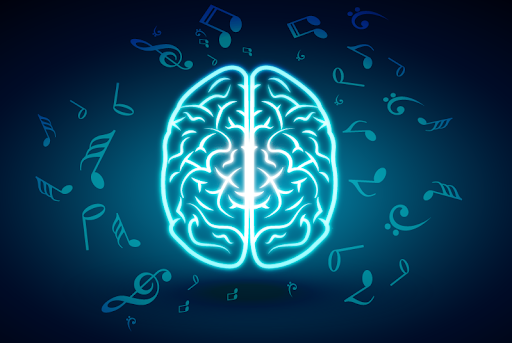
Music doesn’t simply entertain us — it actively reshapes the brain’s electrical activity, or “brain waves.” Through processes like neural entrainment (the process where the brain’s electrical activity synchronizes with an external rhythmic stimulus, such as sounds, speech, or flickering lights) (Wikipedia), music can synchronize with our neural oscillations (brain waves), influencing cognition, emotion, and even therapeutic outcomes.
When music reaches our ears, it starts a chain reaction; sound waves vibrate the eardrum, convert into electrical signals, and are sent via the auditory nerve to the brain’s auditory cortex. According to Harvard Health, “different parts of the brain engage: the cerebellum processes rhythm, temporal lobes decode pitch and timbre, while frontal regions interpret emotional and reward-based features. As these signals propagate, the brain’s electrical activity — its oscillations, or ‘brain waves’ — dynamically adapt.” (Harvard Health).
Moreover, neural entrainment isn’t just a raw reaction, its strength depends on features like melodic complexity. In one electroencephalogram (EEG) study, a noninvasive test that measures the brain’s electrical activity using sensors placed on the scalp, researchers varied the spectral (pitch/harmony) complexity of melodies and found that this increased synchronization in the theta band (~5 Hz), especially for more complex music (PubMed). This shows that our brains don’t just follow rhythm — they also respond more when the music is richer and more musically “interesting.”
Listening to music changes not just the rhythm of brain waves, but how different parts of the brain communicate. In one study using EEG, participants listened to “favorite” music as well as specially chosen “relaxing” music. The researchers found that alpha-band (8–13 Hz) connectivity increased after both kinds of music, but beta-band (higher-frequency) connectivity decreased with relaxing music (MPDI). These changes suggest that relaxing music may help the brain settle into a calm, but focused, state by boosting slower, relaxing brain rhythms and reducing the faster, more “busy” activity.
Long-term musical training can also produce lasting changes in how the brain oscillates. For example, a study compared pianists, string musicians and non musicians to measure their executive function via EEG. Pianists showed greater theta power (the strength or amount of slow brainwave activity) in frontal and motor regions, and stronger theta-band connectivity between prefrontal and parietal areas, suggesting enhanced executive control (MPDI).
In older adults, just three months of music training led to reduced theta power during response-inhibition tasks, such as a Go/No-Go task where participants must quickly respond to most signals but withhold their response to specific “stop” cues, and decreased connectivity between frontal, visual, and auditory regions — highlighting music’s potential to fine-tune inhibitory control.
It’s not just rhythm or training — pleasure from music also ties into brain waves. A causal study used transcranial alternating current stimulation (tACS) to boost theta activity in the right auditory cortex, while participants listened to unfamiliar melodies. When theta stimulation was applied, people reported stronger liking, especially for simple songs, and showed increased theta-band connectivity between right temporal and frontal regions (PubMed). This suggests that these slow brain rhythms help shape how we feel rewarded by music by connecting what we hear with what we expect and how we emotionally respond.
Perhaps most strikingly, music can amplify brain stimulation techniques. Neuroscientists at Stanford timed transcranial magnetic stimulation (TMS) pulses — a noninvasive method that uses magnetic fields to activate specific parts of the brain — to musical beats using EEG. They discovered that brain waves in the motor cortex consistently dip about 200 milliseconds before a dominant beat (Stanford Health). By delivering TMS just before, rather than on, the beat, the team boosted its effect by 77%. As Jessica Ross, one of the researchers, put it: “There are going to be very specific times at which your brain is most ready for the TMS effect.” (Stanford Health). This effect temporarily enhances or modulates the activity of targeted brain regions, which can improve learning, attention, or other cognitive functions depending on where and when the stimulation is applied. These findings hint at new, personalized ways to combine music with brain stimulation in therapies, such as treating depression or other neurological disorders.
Music has a powerful ability to influence the brain’s electrical rhythms, shaping how we think, feel, and respond to the world around us. By helping the brain get into certain activity patterns, improving communication between different brain areas, and activating regions involved in pleasure and decision-making, music becomes more than just sound — it becomes a tool for shaping how your brain feels and works. Whether enhancing relaxation, sharpening cognition, or even boosting the effectiveness of brain-stimulation therapies, the evidence shows that music interacts deeply with the brain’s rhythmic architecture. As research continues, scientists’ understanding of how music and brain waves work together may open new possibilities for improved health, learning, and emotional well-being.