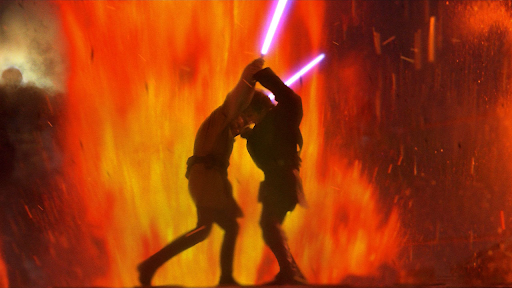
The fall of Anakin Skywalker stands as one of the most intricately constructed tragedies in modern film storytelling. Across the Star Wars prequel trilogy, Anakin’s transformation from gifted youngling to Darth Vader is presented not as a moment of sudden corruption, but as a gradual unraveling of character driven by emotional instability, conflicting loyalties, and carefully manipulated vulnerabilities. George Lucas crafts Anakin not as an archetypal villain but as a flawed and deeply human figure whose strengths—loyalty, passion, and love—become the very traits that lead him into darkness. His downfall reveals how even heroic intentions can be distorted when fear and emotional turmoil occur.
Central to Anakin’s collapse is his overwhelming fear of loss, a fear rooted in his childhood separation from his mother. In The Phantom Menace (1999), the first of the Star Wars prequel trilogy, Anakin’s attachment to Shmi (Anakin’s mother) is already profound, and the trauma of leaving her behind plants the seeds of anxiety that later influence his decisions. This emotional wound is reopened in Attack of the Clones (2002), the second of the prequels, when he witnesses her death, an event that transforms his fear into a compulsive need for control. His massacre of the Tusken Raiders is not merely an act of rage but a sign of his desperation to prevent similar suffering in the future. When Anakin begins experiencing visions of Padmé’s (Anakin’s love interest) death in Revenge of the Sith, this fear escalates into obsession. It is this vulnerability—his inability to accept the inevitability of loss—that becomes the core leverage used to pull him away from the Jedi path. Anakin’s downfall thus begins with love, but it is a love driven by terror rather than trust.
However, fear alone does not account for his fall. Anakin’s emotional impulsiveness and internal conflict further erode his stability. Throughout Attack of the Clones and Revenge of the Sith (2005), his frustration with the Jedi Council reveals a growing disconnect between his self-perception and the discipline the Order expects of him. He is undeniably powerful, yet he feels constrained, misunderstood, and untrusted. His increasing anger—often directed at authority, failure, or perceived disrespect—shows how poorly he navigates his emotions. George Lucas emphasizes that Anakin’s psychological struggle is not rooted in innate darkness but in a lack of emotional guidance. His power grows rapidly, but his ability to cope with responsibility does not. The tension between these two aspects contributes significantly to his instability.
Another crucial factor in Anakin’s fall is the complex web of relationships around him, particularly his contrasting bonds with Obi-Wan Kenobi and Chancellor Palpatine. Obi-Wan serves as mentor, brother, and friend, yet their relationship is often strained by miscommunication and conflicting expectations. Obi-Wan believes in Anakin’s potential but frequently struggles to understand his emotional needs. In contrast, Palpatine positions himself as a constant source of validation, offering Anakin the empathy, encouragement, and praise he feels the Jedi withhold. Palpatine’s influence is gradual and subtle, shaping Anakin’s worldview until the young Jedi begins to view him as the only person who genuinely understands his fears. By the time Anakin faces the choice between the Jedi and the Sith, his emotional dependence on Palpatine makes resistance nearly impossible.
Anakin Skywalker’s fall is ultimately a tragedy of emotion rather than ideology. He seeks certainty in a life marked by fear, love, and self-doubt, and in doing so makes a series of choices that slowly erode his moral foundation. His transformation into Darth Vader is not the result of a single catastrophic decision but the culmination of years of emotional struggle and contradicting external influence. Lucas’s portrayal of Anakin remains compelling precisely because it mirrors the complexity of human vulnerability: even the most heroic individuals can fall when they allow fear to guide their actions.
Works cited:
Star Wars: Episode I — The Phantom Menace. Directed by George Lucas, performances by Liam Neeson, Ewan McGregor, and Jake Lloyd, Lucasfilm, 1999.
Star Wars: Episode II — Attack of the Clones. Directed by George Lucas, performances by Hayden Christensen, Natalie Portman, and Ewan McGregor, Lucasfilm, 2002.
Star Wars: Episode III — Revenge of the Sith. Directed by George Lucas, performances by Hayden Christensen, Natalie Portman, and Ewan McGregor, Lucasfilm, 2005.